
Built in 1990 and licensed for worship by the then bishop of Durham, David Jenkins, the award winning chapel at St Antony’s Priory has the distinction of being the first monastic building to be constructed in Durham since the Reformation.
To step into this space is to step out of the busyness and business of the ‘normal’ everyday world, and into a place of stillness and calm. This is the central hub around which the life of the Priory revolves, defining the structure of the day and shaping the ethos of everything else we do here. The chapel timetable follows a pattern of daily prayer, every weekday morning, together with the regular celebration of the Eucharist, and sung services on Sundays and the major festivals of the Christian year. Our worship is in the catholic tradition of the Church of England, with a distinctively contemplative feel, incorporating significant periods of silent prayer at all services.
The chapel was built when the community, under Prior Jonathan Ewer, took a bold decision. Sarah Menin, an architecture student, undertook a project to design a new monastery for her Master’s degree. So impressed were they by her idea for the chapel, that they decided to build it! Sarah wrote these comments about the design:
The client (SSM) required a building sympathetic to unaccompanied sung services, which would be usable by both the present Community on a daily basis, and could be used by larger numbers on special occasions. The spiritual emphasis of the Christian life is inward looking and contemplative. This emphasis held alongside the outward looking concern for society, the splendid views of the Cathedral and the Priory’s relative isolation, lends itself to a unique scheme which embraces both these themes.
The inspiration of the chapel was for a space rising heavenwards lit by clerestories and with seating arrangements which focused around a centrally placed table. Internally and externally construction is of a natural stone (Dunhouse Sandstone) with Welsh slate roof. Green Westmorland slate is incorporated into the floor and tiered seating. In unity with the remainder of the scheme the chapel seeks to emphasise the richness of simple form, line and design together with durable materials.
Internally the chapel is circular with the altar in the centre. The altar is marked out as the principal feature and the point of convergence in the chapel. With clarity, the altar stands in stark simplicity. The space above the altar, its tower shape, may be regarded as an extension upwards to God and the heavens. The difficulty with this circular spatial concept is that it lacks direction. This is resolved by placing a glazed entrance door at one end and a high east window and tabernacle at the other. Thus there is a feeling of movement within the whole design. Light (both natural and electric) is over the most significant space, the altar.
Many who have visited the Priory, or attended services in the chapel, will appreciate the purity and understated elegance of its design. What many may not know is that it was always intended to have stained glass in the large main window. At the time of construction, a design was commissioned from Norman Adams RA, but for various reasons the work was never completed.
The present Director, Nicholas Buxton, felt that the original vision of the chapel should be completed with the addition of stained glass. In 2024, Sophie Hacker, an artist specialising in church art, was commissioned to develop a new concept. Explaining her design Sophie says:
The circle in the principal window refers directly to the presence of Christ, and the gift of his life offered on the cross for the salvation of creation. By using the same device in the other three windows, I reference Christ’s eternal connection with the life of the world as expressed in the elements of earth, air, fire and water.
The principal window contains traces of all four colours used, but the use of those colours make more sense when the other three are present. In the red, the circle emerges from the heart of the flame, drawing our eyes to its centre. It evokes the rising sun and resurrection. In the green, where the sun sets, the circle breaks into the line of abstracted trees, bringing a golden glow to the earth as a symbol of redemption. In the yellow, which represents angels’ wings, the circle has been designed to frame the elevation of the host at mass, reminding us of the eternal presence of Christ.
The use of circles in all the windows enriches the conversation between the windows and the altar at the heart of the chapel. The proportions of the circles used in the windows speak directly to the top of the altar, which comprises of two overlapping wooden discs. The tabernacle, with its semi-circular symbols, is also drawn into the conversation. The design concept of the windows honours the architectural essence of the chapel through the fluidity and light touch of their structure, allowing the balanced proportions of the space to continue to sing.

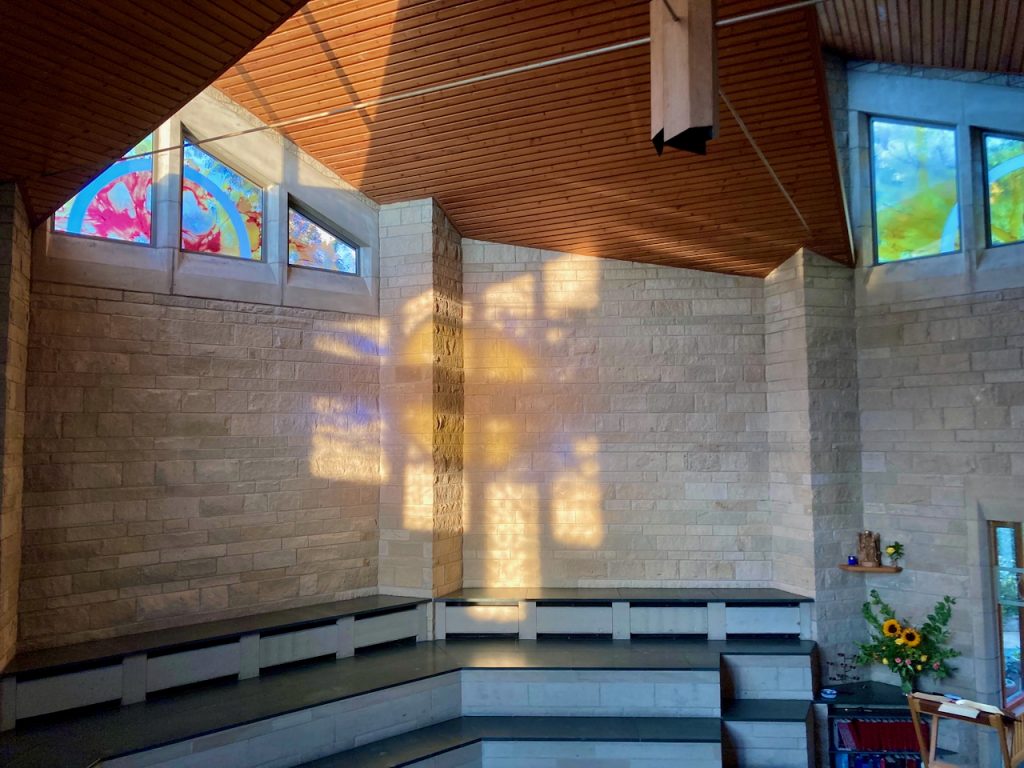
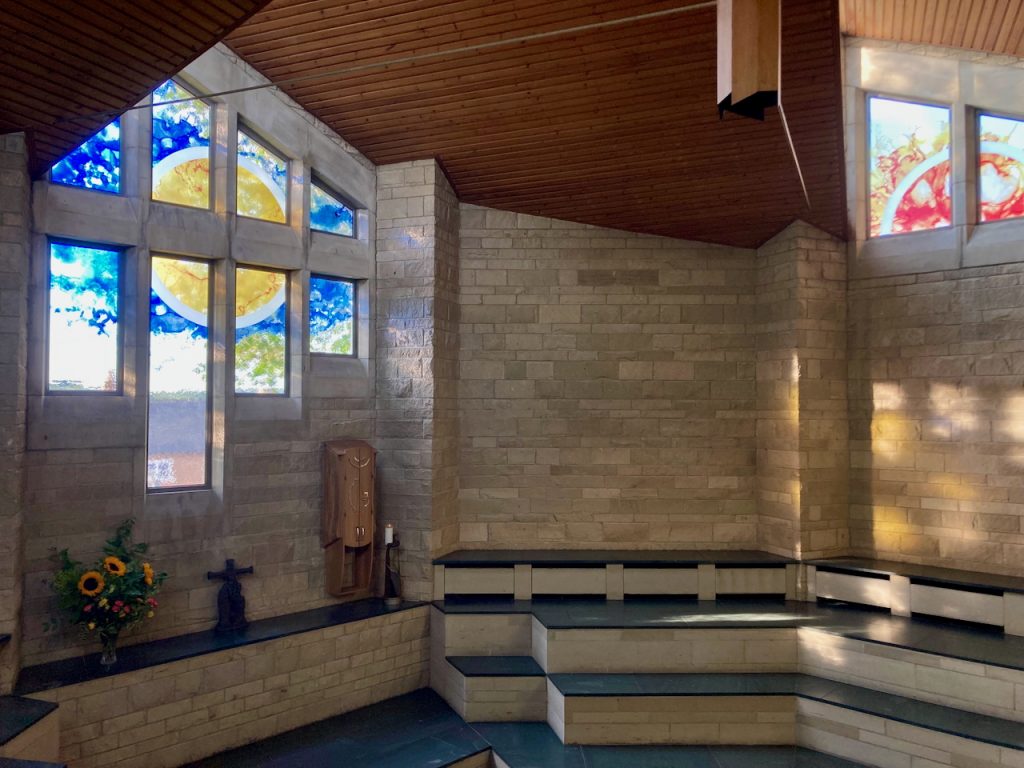
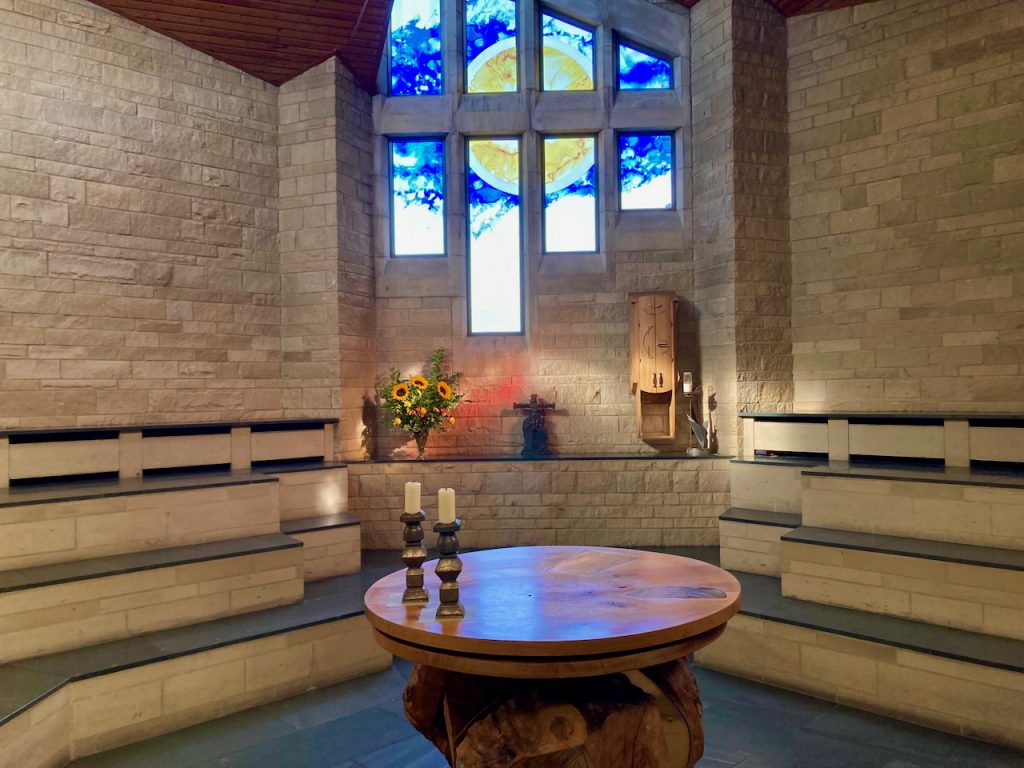
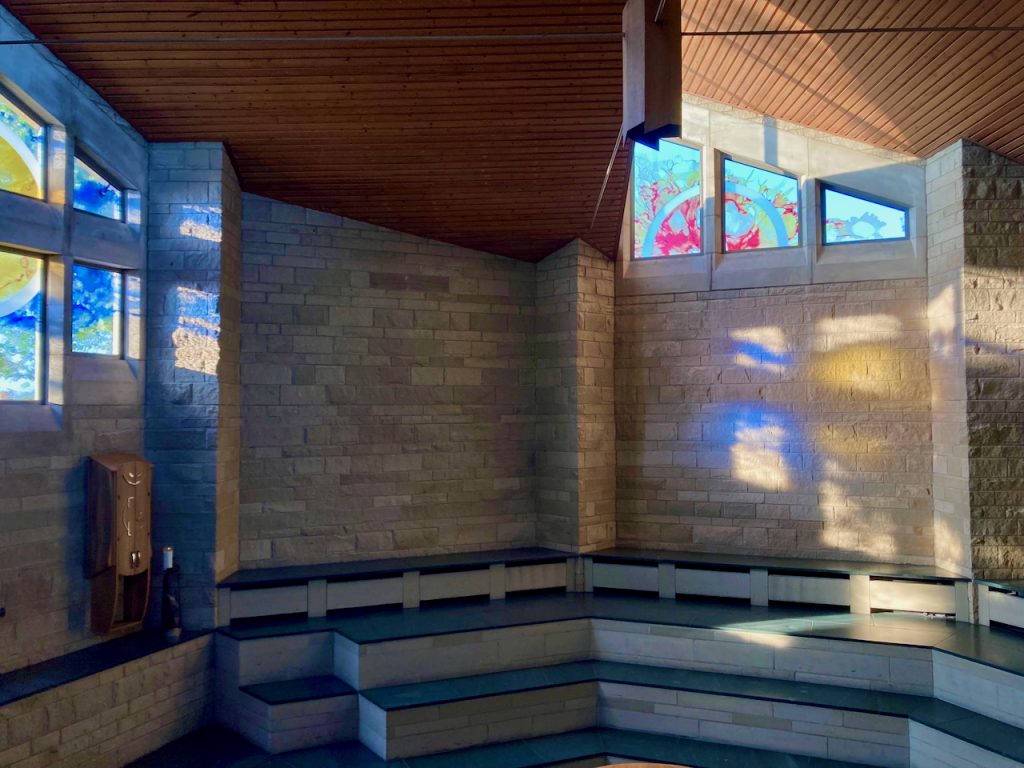
The new windows were installed in July 2025, and they are absolutely stunning. A service of dedication, led by Rt Revd Stephen Conway, Bishop of Lincoln and sometime Episcopal Vistor to SSM was held on Sunday 28 September 2025, which was kept as the Feast of St Michael and All Angels, the Patronal Festival of the Society.
All are welcome to attend any of our services; for details see here.